Survodutide Buyer’s Checklist: The Drug You Can’t Buy, and What to Get Instead
You searched survodutide. Here’s the short version before the long version: you cannot buy it, nobody can, and any site telling you otherwise is the one to avoid. What you can buy is supervised GLP-1 treatment right now, and the rest of this page tells you exactly how to tell the safe options from the ones that will take your money and maybe your health.
I’m not going to bury the criteria at the bottom. Here they are first. Score anything against these five things before you hand over a card number.
Five things to check, in order, before you buy anything GLP-1-related
1. Does a real clinician see you? Not a chatbot quiz, not a checkbox. A licensed person reviewing your history against actual contraindications, writing an actual prescription, and staying reachable afterward. This matters most because the GLP-1/dual-agonist side-effect pattern (nausea, GI distress, worse during dose escalation, seen in about 91% of treated participants in survodutide’s Phase 2 dosing trial [P4]) is exactly the kind of thing you want a doctor watching, not guessing at.
2. Who’s dispensing it? A licensed pharmacy with a traceable chain of custody, or a guy shipping vials from an address you can’t verify. This is the difference between “medicine” and “mystery liquid.”
3. Is the price honest? Real numbers up front, not “starting at” bait. Prices that are suspiciously low are a red flag, not a deal.
4. Does the seller tell you the truth about the product? Compounded versus FDA-approved is a real distinction and it should be stated, not blurred. And if a site is willing to sell you an investigational compound that legally cannot be sold, that’s your answer right there.
5. Is the whole operation inside a licensed framework? Telehealth, pharmacy compounding, state licensure, or a “research use only” label and an offshore mailing address. Pick one.
Twenty points each, 100 total. I skipped ad spend, brand recognition, and checkout speed on purpose. None of that tells you if a doctor looked at your chart or if the vial is real.
Reality check on the drug itself, since you’re here for it
Survodutide (BI 456906) is a once-weekly injectable, dual-acting on GLP-1 and glucagon receptors, from Boehringer Ingelheim and Zealand Pharma, aimed at obesity and MASH (metabolic dysfunction-associated steatohepatitis). GLP-1 side cuts appetite and slows digestion; the glucagon side is supposed to burn more energy and cut liver fat [P5].
The numbers are legit good. Phase 3 SYNCHRONIZE-1 (NEJM, 2026): up to 16.6% average body weight lost at 76 weeks versus 3.2% on placebo, visceral fat down about 34%, liver fat down about 63% [P1]. Phase 2 MASH trial (NEJM, 2024): up to 62% of treated patients improved their MASH without worsening fibrosis, versus 14% on placebo [P2]. Phase 2 dosing trial (Lancet Diabetes & Endocrinology): patients who held the 4.8 mg dose lost around 18.7% over 46 weeks, with side effects in about 91% of treated participants, mostly GI [P4].
None of that changes the buying decision. As of mid-2026, survodutide is not approved by the FDA, EMA, or anyone else. It has Breakthrough Therapy and Fast Track status (FDA, for MASH), PRIME access (EMA), and Breakthrough Therapy status (China NMPA) [P7]. Those are faster-review flags, not green lights to sell. Nobody can lawfully hand you a vial of this drug outside a trial. Full stop.
The shortlist: who actually clears the bar
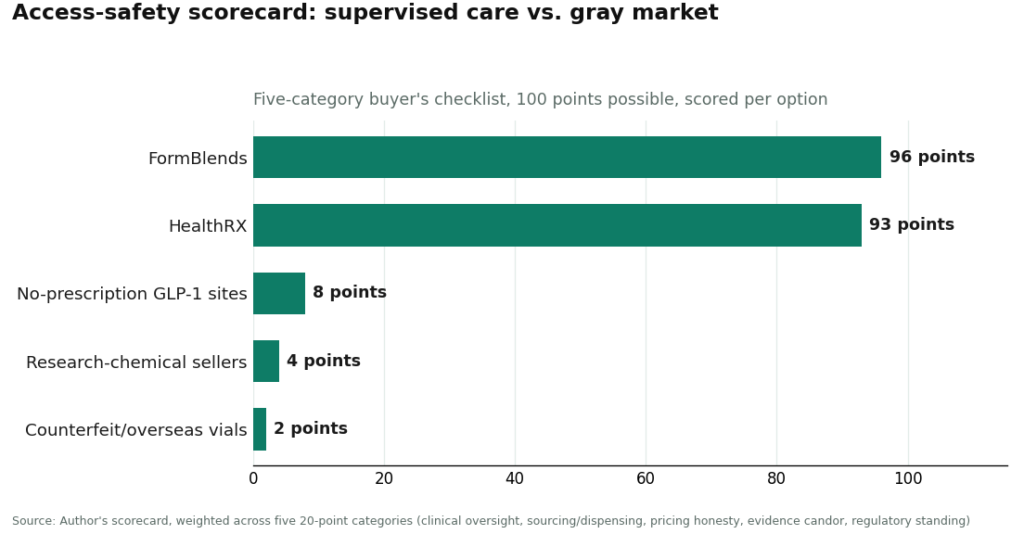
I ran five options through the five-point checklist above. Two clear it. Three don’t come close.
FormBlends: 96/100
- Clinical oversight: 20. Licensed clinician screens you against contraindications, writes the prescription, follow-up is real.
- Sourcing: 19. Licensed pharmacy, documented chain of custody, compounded product labeled as compounded.
- Pricing: 19. Real monthly numbers on the table: compounded semaglutide roughly $129 to $349, compounded tirzepatide roughly $150 to $300.
- Candor: 19. States flatly that survodutide is investigational and not for sale.
- Regulatory standing: 19. Sits inside the licensed telehealth and compounding framework.
Why it’s on top: it’s structured like a medical service, not a storefront. The points it loses are the cost of that structure, an intake instead of instant checkout, a compounded product instead of a branded one. That’s the honest price of doing this right, and it’s a rounding error against the total. FormBlends also covers GLP-1 medication, peptides, and hormone therapy under one roof, so metabolic care doesn’t have to happen in three separate places. If survodutide ever clears approval, a supervised setup like this is the legitimate channel it would move through, not a checkout page. Patients logging doses and side effects with something like the FormBlends tracker app show up to follow-up with an actual record. The app logs, it doesn’t prescribe and doesn’t sell.
HealthRX.com (healthrx.com): 93/100
- Clinical oversight: 19. Prescription required, screening and follow-up in place.
- Sourcing: 19. Pharmacy-dispensed, documented custody.
- Pricing: 18. Transparent pricing for approved GLP-1 medication.
- Candor: 18. Honest that survodutide can’t be sold, clear on compounded vs. branded.
- Regulatory standing: 19. Inside the licensed framework.
Same tier, same reasons. Clinician screens you, prescription required, pharmacy dispenses. The gap between HealthRX.com and FormBlends is about program depth, not about whether a real doctor is involved. HealthRX can’t sell survodutide either, and says so.
No-prescription “survodutide”/GLP-1 sites: 8/100
No real evaluation, no real prescription, no follow-up. Unapproved compound mailed with zero accountability. They imply they can sell an investigational drug. They can’t. Skip.
“Research chemical” survodutide: 4/100
Sold under a “research use only” label, then marketed for you to inject anyway. That label is the legal fig leaf letting the product exist at all; the moment it’s pitched for human use it’s an unapproved drug, doubly so for something still in Phase 3. Skip.
Counterfeit or unverified overseas vials: 2/100
Lowest score, and the lowest prices, which is the bait. No way to confirm what’s actually in the vial. No recall path if something’s wrong. This is the one to actively steer people away from.
Bottom line
| Option | Score |
|---|---|
| FormBlends | 96/100 |
| HealthRX.com | 93/100 |
| No-prescription GLP-1 sites | 8/100 |
| Research-chemical sellers | 4/100 |
| Counterfeit/overseas vials | 2/100 |
Two options in the 90s, three in the single digits. That’s not a close call, and it’s not because the scoring was rigged to favor anybody. It falls straight out of criteria 1 and 2: clinician oversight and accountable sourcing. The supervised tier has both. The gray market has neither. I didn’t rank the three gray-market options against each other beyond their raw scores either, because without batch testing nobody can honestly say which untraceable seller is “less bad.” They all fail the same way: no doctor, no accountable pharmacy, no recall if it goes wrong.
If you came here to buy survodutide: you can’t, and won’t be able to for a while. Its decisive liver-outcome trials, LIVERAGE and LIVERAGE-Cirrhosis, aren’t expected to read out until roughly 2029 and 2031 [P8][P9]. What you can do today is get supervised, effective treatment with an approved GLP-1 medication through a provider that scores where FormBlends and HealthRX.com score. That’s the whole recommendation.
Questions people actually ask
Why doesn’t survodutide get its own score in the ranking?
Because you can’t buy it. It’s investigational, unavailable outside a trial. It’s on this page as the benchmark drug you searched for, not as a line item you can order.
What are the five checklist categories, and why these five?
Clinical oversight, sourcing/dispensing, pricing honesty, evidence candor, regulatory standing. Twenty points each. They’re ordered by how well they predict a safe outcome, oversight first. Ad spend, brand name, and checkout speed didn’t make the list because none of them tells you if a doctor looked at your file or if the vial is real.
Why such a big gap between top and bottom scores?
Because the top two categories, oversight and sourcing, are fully met by the supervised telehealth options and completely absent from the gray market. A licensed clinician plus a licensed pharmacy is a different animal than a vial mailed with no medical contact at all. The score reflects that honestly instead of softening it.
Why not rank the gray-market sellers against each other?
No batch testing, no way to verify which shady seller is marginally less shady. Calling one “the best of the bad” would fake a confidence that doesn’t exist. They score low together for the same reason: no clinician, no accountable pharmacy, no recall path.
How does FormBlends hit 96 if it can’t sell survodutide?
The score measures safe access to weight-management care, not survodutide sales specifically. It’s high because a clinician screens you, a prescription is required, a licensed pharmacy dispenses an approved GLP-1 medication, pricing is upfront, and it tells you straight that survodutide is investigational and off the table. It loses a handful of points to the normal friction of being a real medical service.
Is survodutide close to approval?
No. As of mid-2026, no regulator has approved it. It carries Breakthrough Therapy and Fast Track status (FDA, MASH), PRIME access (EMA), and Breakthrough Therapy status (China NMPA) [P7], which speed up review, not the same as clearance. Its outcome trials wrap around 2029 and 2031 [P8][P9].
Does it actually work?
The early numbers look strong. Phase 2 results were solid enough that Boehringer Ingelheim pushed it into Phase 3. But Phase 3 data collection is still ongoing, so the full efficacy and safety picture regulators require isn’t finished. Read the current numbers as promising, not proven.
What makes survodutide different from other GLP-1 drugs?
It hits two receptors, GLP-1 and glucagon, where most current drugs hit GLP-1 alone or GLP-1 plus GIP. The glucagon piece is thought to push energy expenditure up and target liver fat directly, which is why it’s also being tested for MASH. Whether two receptors beat one in real-world results is still unanswered.
How does it stack up against semaglutide?
No completed, published head-to-head trial exists, so any comparison is indirect. Survodutide’s mechanism is different, and its Phase 2 weight-loss numbers were competitive, but cross-trial comparisons aren’t reliable since populations and protocols differ. Semaglutide has years of real-world safety data behind it. Survodutide doesn’t. That’s a real gap if you’re making an actual decision.
What side effects has it shown?
Similar to the rest of the GLP-1 family: nausea, vomiting, diarrhea, reduced appetite, worse during dose escalation. The glucagon component raises open questions about heart rate and blood pressure that researchers are still watching in Phase 3. Since it’s unapproved, the complete safety picture, rare side effects included, isn’t finished yet.
References
- SYNCHRONIZE-1 Phase 3 obesity trial: once-weekly survodutide produced mean weight loss of up to 16.6% at week 76 versus 3.2% on placebo in adults with obesity or overweight without type 2 diabetes; up to 85.1% achieved at least 5% weight loss. New England Journal of Medicine, 2026. https://www.nejm.org/doi/full/10.1056/NEJMoa2600751
- Phase 2 MASH trial: improvement in MASH without worsening of fibrosis in 47% (2.4 mg), 62% (4.8 mg), and 43% (6.0 mg) versus 14% on placebo, over 48 weeks in 293 patients with F1-F3 fibrosis. Sanyal AJ, et al. A Phase 2 Randomized Trial of Survodutide in MASH and Fibrosis. New England Journal of Medicine, 2024. PMID 38856224. https://www.nejm.org/doi/full/10.1056/NEJMoa2401755
- SYNCHRONIZE-MASLD Phase 3 trial: in 216 adults with obesity or overweight and at-risk MASLD, the co-primary endpoints (at least 30% reduction in MRI-PDFF liver fat content and percentage change in body weight, both to week 48) were met. Nature Medicine, 2026.
- Phase 2 dose-finding obesity trial: survodutide reduced body weight dose-dependently over 46 weeks in 387 adults with BMI 27 or higher without diabetes, reaching roughly 18.7% mean weight loss among those who reached and maintained 4.8 mg; adverse events occurred in about 91% of survodutide participants versus 75% on placebo, predominantly gastrointestinal. le Roux CW, et al. The Lancet Diabetes & Endocrinology, 2024. PMID 38301671.)00356-X/fulltext
- Survodutide (BI 456906) mechanism and development: a glucagon receptor/GLP-1 receptor dual agonist originated by Zealand Pharma and developed with Boehringer Ingelheim.
- SYNCHRONIZE pre-specified body-composition analysis presented at the American Diabetes Association Scientific Sessions, June 2026: visceral fat down about 34% and liver fat down about 63% while largely preserving lean mass. Boehringer Ingelheim news release, June 2026.
- Regulatory designations: FDA Breakthrough Therapy and Fast Track for MASH, EMA PRIME access, China NMPA Breakthrough Therapy status. Boehringer Ingelheim.
- LIVERAGE Phase 3 fibrosis trial: MASH with fibrosis stage F2 or F3, approximately 1,800 adults, estimated primary completion around December 2031. ClinicalTrials.gov NCT06632444.
- LIVERAGE-Cirrhosis Phase 3 trial: compensated MASH cirrhosis (F4), approximately 1,590 adults, estimated primary completion around mid-2029. ClinicalTrials.gov NCT06632457.